You have not added anything yet.
Subtotal0,00 €
Figures are taken from the CIMAVET summaries of product characteristics: fipronil 3370/3371/3372 and permethrin 3772/3773.
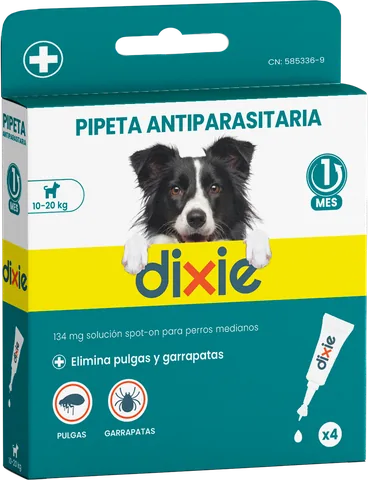
It depends on the active ingredient. For fipronil, the summary of product characteristics specifies a minimum interval of four weeks between treatments. With permethrin, each spot-on prevents new flea and tick infestations for up to four weeks. If your dog swims or bathes frequently, protection may not last as long.
Do not let your dog get wet or bathe them until at least two days after application: the active ingredient needs this time to spread across the skin and coat. Avoid frequent bathing, which can reduce efficacy.
That is why it is applied to the back of the neck, between the shoulder blades, where your dog cannot reach with their tongue. If they still lick it and you notice anything unusual, call your vet.
No. Doses are based on weight bands, and splitting one does not guarantee each dog receives the correct dose. Use the spot-on for each dog’s weight band.
It depends on the active ingredient. Fipronil can be used from eight weeks of age in dogs weighing more than 2 kg. Permethrin can be used from two weeks of age; for dogs under 2 kg, only following your vet’s assessment.
Yes. With the fipronil spot-on, fleas start dying promptly and protection lasts up to 5 weeks. Ticks already present may take up to a week: not all die within the first 48 hours. If your dog already has ticks, remove them manually.
This almost always means they are emerging from the environment, rather than the product failing: eggs and larvae already in the home continue their life cycle for weeks. You also need to treat the home. We explain the full process in the flea guide.
No. Dog spot-on treatments are for dogs only and can cause an overdose in cats. Dixie offers a fipronil spot-on treatment for cats, with its own dose. Permethrin is toxic to cats: keep the treated dog away from them for 72 hours.
Yes. Antiparasitics are veterinary medicinal products, which is why they are not sold online: you can find them at your usual retailer. Official information is available in CIMAVET, from the AEMPS.
Do not combine them on your own initiative. Doubling the product does not double protection and may result in excessive exposure to the active ingredient. If you think your dog needs more protection, ask your vet.
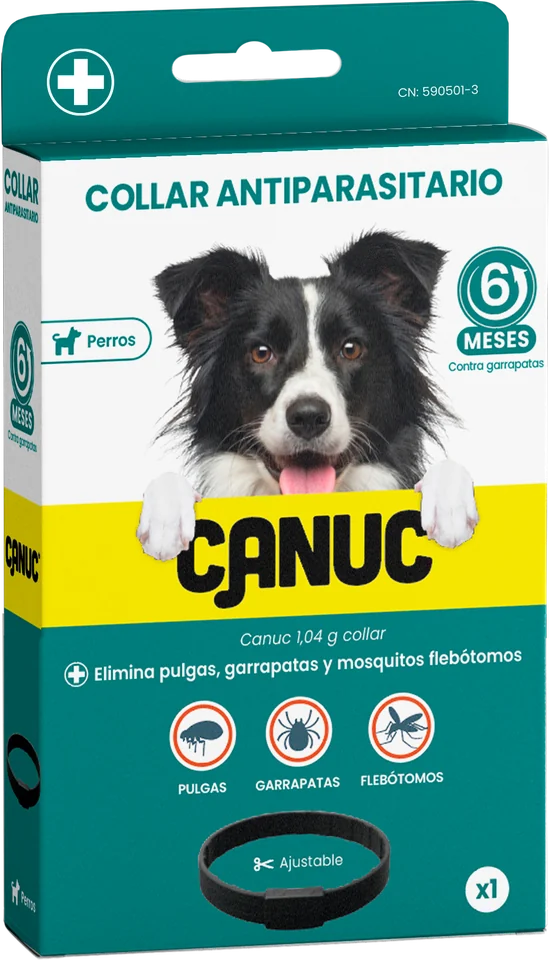
It depends on the model: some last several months. Each product specifies its exact duration. Keep it in its sealed bag until use.
For shampooing, yes: according to the summary of product characteristics, occasional wetting does not reduce efficacy, but the effects of shampooing or immersion have not been studied. Put it back on when your dog is completely dry. Do not let your dog enter rivers or streams while wearing it: deltamethrin is toxic to aquatic organisms.
Snug but not tight: you should be able to fit two fingers between the collar and the neck. If it is loose, the active ingredient does not spread properly through the coat. Trim off the excess once fitted.
According to its summary of product characteristics, the deltamethrin collar prevents sand fly bites for 5.5 months. If you live in a risk area and have questions about protecting your dog, ask your vet.
Do not combine them. The summary of product characteristics for the deltamethrin collar states that it must not be used with other pyrethroid ectoparasiticides, and the antiparasitic shampoo contains tetramethrin, which is one. Ask your vet if you have any questions.
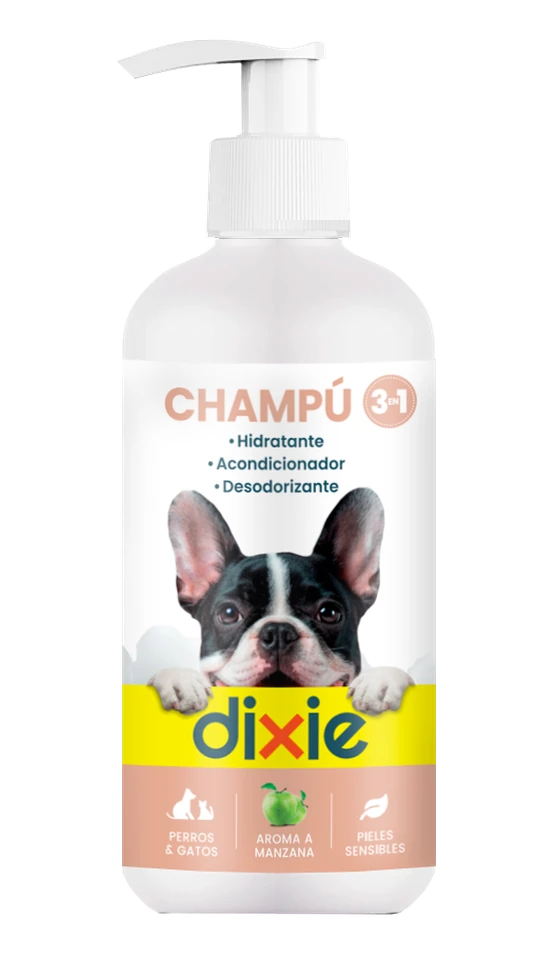
Hygiene shampoos are designed for routine dog bathing. Avoid overdoing it: bathing too often dries out the skin, whatever shampoo you use. The antiparasitic shampoo is different: according to its summary of product characteristics, treatment is repeated every 3-4 weeks.
They are different treatments, each with its own schedule, and should not be used together: the fipronil spot-on summary of product characteristics says not to combine it with other flea products applied to the dog, and the permethrin spot-on must not be combined with other pyrethroids. Ask your vet which suits your dog.
It depends on the product. Always check the label before use on a puppy.
Dixie hygiene products are shared: the bathing shampoos are suitable for dogs and cats, as there is no separate cat range. The exception is the antiparasitic shampoo, which is for dogs only. Never apply anything containing permethrin to a cat: always check the label.
On dry hair, without rinsing: shake the bottle, spray particularly on tangled areas, massage to distribute and brush. Full instructions are on the packaging.
It is formulated for dogs and cats; it is not a human fragrance. Do not apply near the eyes or to open wounds.
Digestive's composition is taken from its packaging label; information on Mobility and Relax is based on how they are presented on dixie.es.
No. They are complementary feeds: they supplement the diet and do not treat disease, so no prescription is needed. If your dog has a diagnosed health condition, consult your vet before changing their diet.
Daily, as part of the routine, rather than just as an occasional reward: they are intended for regular use. The amount for your dog’s size is shown on the packaging.
Yes. Mobility, Digestive and Relax can be used together, as each is designed for a different purpose.
It is not a sedative and does not affect your pet’s consciousness. Dixie presents it as containing lemon balm and chamomile for stressful moments: thunder, fireworks, car journeys or being home alone.
If your dog has a diagnosed food allergy, read the product’s full composition before offering it and check that it contains no ingredients they react to. The composition is on the label and each treat’s product page.
They are formulated for adult dogs. The exact minimum age is shown on the packaging.
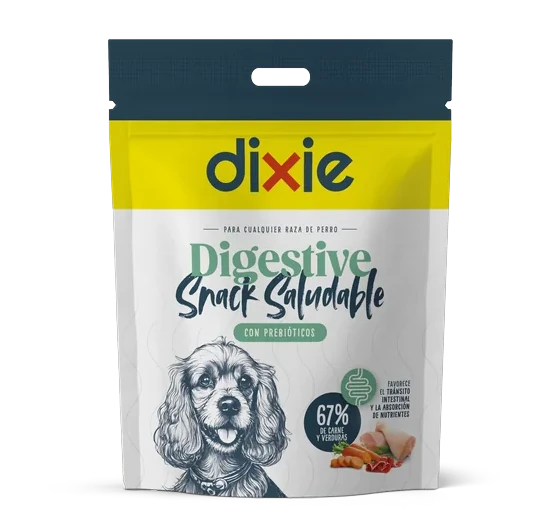
Digestive contains a probiotic, the yeast Saccharomyces cerevisiae, which makes up 7% of the recipe according to its packaging. Dixie presents Mobility as containing glucosamine and chondroitin, and Relax as containing lemon balm and chamomile.