You have not added anything yet.
Subtotal0,00 €
The insect that transmits it, the sand fly, measures two millimetres and emerges at dusk. Prevention is far more effective than treatment.
Here are the symptoms to watch for, the areas at risk and how to protect your dog before it bites.
The vector
It is not a mosquito: it is a different, much smaller insect, and the only one that transmits Leishmania. The dot below is shown at actual size on your screen.
Actual size · 2–3 mm
Sand flies can pass through standard mosquito netting and fly silently, so they go unnoticed. They bite at dusk and during the night in the warmer months.
Four openings in standard mosquito netting, also at actual size: 1.4 mm each.
Leishmaniasis is a parasitic disease caused by the protozoan Leishmania infantum. It mainly affects dogs, although it can also be transmitted to people: it is a zoonosis.
The bite leaves no recognisable mark. For weeks, months and sometimes years, the parasite multiplies inside immune system cells while the dog appears healthy. When symptoms appear, they develop gradually and are easily mistaken for other conditions.
There is no commercially available vaccine in Spain with universally demonstrated efficacy. Treatment exists, but it is lengthy, expensive and does not always achieve a complete cure. Prevention is by far the best option.

What to look for
Each point marks an area where leishmaniasis first becomes visible.
Conjunctivitis and persistent eye discharge, often in both eyes at once.
Crusting, scaling and hair loss along the ear margins. Often among the first signs, and easily mistaken for an allergy.
Excessively long, curved claws. Known as onychogryphosis, this is a very characteristic sign.

Ulcers and crusts around the muzzle that fail to heal.
A dull, lacklustre coat, with patches of hair loss across the body.
None of these symptoms is exclusive to leishmaniasis. That is why the overall picture matters: if you notice several together, especially if you live in a risk area, ask your vet for a test.
Where and when
Risk areas in Spain include the Mediterranean coast, the eastern regions, Andalusia and Extremadura. Select your area to see which months protection is advisable.
An eastern region with high prevalence. On the coast, the vector may be active almost year-round, so protection should not stop in winter.
Risk months
High prevalence and a long season due to the warm climate.
Risk months
High prevalence, particularly in Málaga, Almería, Seville and Cádiz. The climate extends the season.
Risk months
A Mediterranean region, with historical hotspots around Barcelona and Tarragona. Risk is concentrated in the warmer months.
Risk months
Moderate to high prevalence, with high risk in summer.
Risk months
A documented active hotspot in the south of the region. Clear summer risk.
Risk months
A Mediterranean area, with the season concentrated in the warmer months.
Risk months
Confirmed presence on certain islands. The climate extends the period of activity.
Risk months
Outside the traditional risk area, but with documented and increasing cases.
Risk months
Outside the traditional risk area, with increasing prevalence.
Risk months
Historically low risk, with new cases in recent years. Protection is advisable when travelling south.
Risk months
Sand flies are moving north with climate change: areas historically considered low risk are recording new cases. Epidemiological data from ESCCAP and the Ministry of Health. Map: © Instituto Geográfico Nacional (CC BY 4.0).
Prevention
With sand flies, what matters is preventing the bite.
The insect dies, but only after biting: the bite has already occurred.
According to their summaries of product characteristics, the permethrin spot-on repels sand flies for 1 week after each application, and the deltamethrin collar prevents their bites for 5.5 months.
What the summary of product characteristics or packaging says about each Dixie dog product.
 Never use on cats. Permethrin and deltamethrin are toxic to them.
Information from the CIMAVET summaries of product characteristics (fipronil 3370-3372, permethrin 3772 and 3773, deltamethrin 4186) and repellent packaging. If you live in a risk area, ask your vet how to protect your dog.
The two Dixie antiparasitics that, according to their summaries of product characteristics, repel sand flies or prevent their bites.
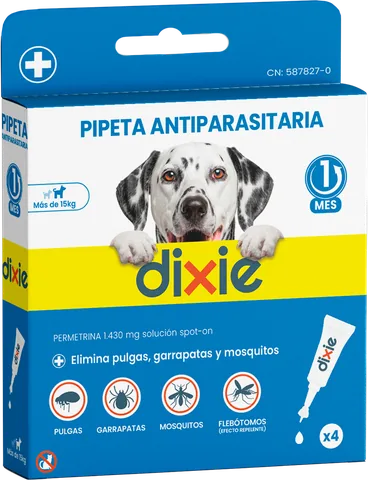 Permethrin antiparasitic spot-ons for dogs
Kills fleas and ticks, and repels sand flies for 1 week per application.
Where to buy View product→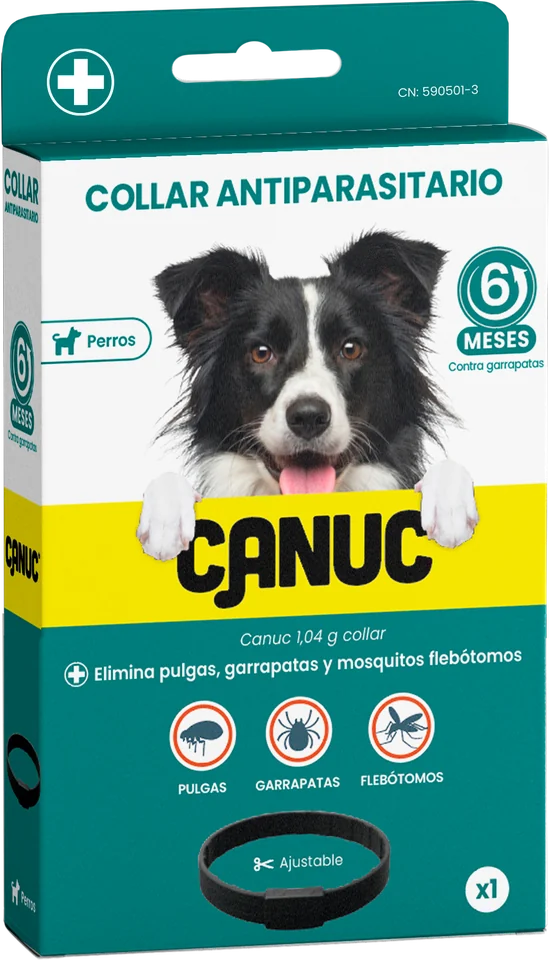 Antiparasitic collar for dogs
Fleas, 16 weeks; ticks, 6 months; sand flies, 5.5 months.
Where to buy View product→Treatment exists and can control the disease, but does not always achieve a complete cure. Many treated dogs remain carriers and may relapse. That is why prevention is far more effective than treatment.
It is a zoonosis, so it can be transmitted to people. However, not through direct contact with the dog: transmission also requires a sand fly bite. People with weakened immune systems are more vulnerable.
According to their summaries of product characteristics, the permethrin spot-on repels sand flies for 1 week after each application, and the deltamethrin collar prevents their bites for 5.5 months. Both are veterinary medicinal products: read the package leaflet and ask your vet if you have any questions.
According to their packaging, they repel fleas, ticks, mosquitoes and mites. Sand flies are not included.
It depends on the product. Check the summary of product characteristics or package leaflet before using it on puppies.
Sand flies are mainly active between May and October. In warmer areas, the risk may extend to other months.